Monday, December 17, 2012

Cultural Event 5

The Hobbit in 3D:


As a part of the cultural event portion of my senior capstone, I attended The Hobbit: An Unexpected Journey. I saw the movie in 3D, and was interested to see how the book was adapted to the big screen. I was particularly interested to see what the film crew did with such a long story, and how they would adapt the film to fit a three-movie format.

Overall, the movie did not disappoint. While I am a fan of the book, they did a good job of staying true to the overall theme of the story. Several scenes were altered in order to help with the exposition of the story, and a few action scenes were added that did not appear in the book; however, for a three hour movie I can see why they wanted to add a little more action.

Another thing that struck me about the movie was how the capabilities of 3D were used subtly. Oftentimes, when a movie is made in 3D the filmmaker attempts to "shock" the audience by using 3D effects; which is often jarring, and distracts from the point of the film. In The Hobbit 3D was used carefully, as a way to add depth to perspective shots; not in order to have everything in the environment pop out of the screen.

How this relates to my final project:

In seeing a film that has an already established story brought to the screen, I was reminded that I had undergone a similar process in creating my film. I had though of the story behind my final project for a long time, and it was only recently that I thought of how to adapt it to a film. I think that seeing another story that I had been thinking of for a while (The Hobbit) brought to the screen was helpful when reviewing how I translated my film to movie format.

In seeing a story I was very familiar with on the big screen, I felt that perhaps there was a similarity in what I hoped to do with my final project. Ideas are very important to me as a filmmaker, and seeing ideas come to life on the big screen and on my little screen at our capstone presentation was an important moment for me.

Cultural Event 4

Capstone Session:


For one my my cultural event requirements, I attended the capstone poster session for the Communication Department at Shepherd University. While I was presenting at the event, I also had the opportunity to see what my fellow classmates did for their final projects.

All of the presentations were amazing! There were several radio plays, a marketing plan for a local restaurant, a blog about Appalachian heritage, a display about voice acting, a website for the Shepherdstown Police Department, a comedic film, and a presentation about diseases that effect babies...  a wide range of topics that showcase how diverse the field of Communication is. It was very rewarding to see the projects that my fellow students worked on this semester; they all did a great job and represented our field admirably.

How this fits into my final project:

Seeing what other people in my class accomplished was interesting, and helped me review my final project. In viewing the quality of work that our department produced, I think that our field will continue to have a good reputation; and that because of the level of work that I saw at the presentation, Shepherd will stand out on a resume.

That our department looks good, and that my class produced professional-qulaity work was important to me because much of our capstone class was about using the skills that we've developed throughout our education to produce work that will help us to find employment. Being identified with Shepherd and the Communication Department will be a plus on my resume; and this semester has been an incredible experience!

Cultural Event 3

Dan and Lauren Smith:


As a a part of my cultural event attendance this semester, I went to an event hosted by Ignite a group at Shepherd University. The event featured Dan and Lauren Smith, musicians who moved to Redding PA in order to try and bring healing through music and ministry.

The event began by Dan and Lauren introducing themselves and their mission, and was punctuated by live performances of song they've written. While they played music that from several of their albums, that night they wanted to focus on the Revive Project - music they hope will bring healing to people who have experiencing the troubles of life.

One of the reasons that Dan and Lauren started the Revive Project was that they were confronted by how sad life in Redding is. Redding has many troubles including human trafficking, theft, and a high murder rate. Dan and Lauren talked about how Redding has a higher crime rate than the national average; and about how they hope that their music would help bring healing to the city.


How it tied in to my final project:

This tied in to my final project in that it was inspiring idea of how to use art to bring healing. An important theme in my final project was in showing how my main character heals after an accident that claims his sight. In gaining physical healing through a device that gives sight back to him, he finds a greater sense of healing in realizing that the world is a more beautiful place than he could have imagined.

It was nice to see someone else working to bring healing through art, especially when it is combined with the idea that personal healing can help bring about a greater healing in society.

Here is a link to one of the songs that we heard that night.

Thursday, December 13, 2012

Cultural Event 2

The image was used came from IMDB.com


Recently, as a part of my final project's requirement to attend cultural events, I saw the movie Argo.

Argo is a film based on the real life story of how the CIA used the guise of filming a science fiction film to get several U.S. Embassy staff out of Tehran during the Iranian hostage crisis. The movie was very interesting, and had a documentary-film style that told the personal story of the Agent responsible for the plan to extradite the embassy staff, while noting what was going on around this plan in Iran and in the U.S.

In order to get the staff out of Tehran safely, the CIA agent comes up with a plan to fake the making of a movie; saying that they are scouting for locations in Tehran. The movie they are pretending to make is a rip-off of StarWars, and they convince the Iranian authorities that they are going to use the desert landscape as a backdrop to their movie.

Their plan succeeds in the end, though there are several tense moments; including a scene where the Iranian Revolutionary Guard figures out that the "crew" are actually from the embassy while they are about to board a plan to get out of the country.


How it relates to my final project:

Overall, the movie was very interesting. I found the characters compelling, not the least because they have real-life counterparts. The story tied into my project because it was about putting together a movie,   complete with posters, press kits, etc.

This look into the film industry was interesting because it made me think about how I had to promote my final project through our capstone presentation presentation; and made me think about how a film gets delivered to a wider audience.


Monday, December 10, 2012

Cultural event 1


"72 hours to make a movie? You've got to be kidding me!" -That's the general reaction filmmakers have to the idea of the 72 Film Fest. Nestled in Frederick, MD, this little gem has been posing a challenge for budding filmmakers in the region for the last six years. Every year there is a different challenge posed to the filmmakers, and this year was no exception. Filmmakers were given scripts that were also produced in 72 hours! Over the summer the folks from the 72 hosted their first ever 72 Hour Script Festival. In this way, filmmakers had to work with an already-prepared script (instead of producing one from scratch); and had to adapt and work with their writers as an additional challenge.

My role in this year's film fest was a writer and as the leader of a team. Since last year, I've been leading a team comprised mostly of people from Shepherd University. We are known as Turbo Duck Productions, and though we haven't won anything yet, it has been an adventure every time.

2011:


In 2011, our team produced a film called "Fall from Grace" about a man who has to work through issues that come to a head after the worst day of his life. In 2011, I was the team leader and writer, and had to learn how to do everything in 72 hours. For the team, this film was a challenge to do since we had to come up with a script and shoot the entire movie on the weekend before midterms.


2012:


This year, we made a film called "Principles" by adapting a script by Pat Riley about a man who pretends to hate halloween... but secretly loves it more than anyone else. This film was a lot of fun to make, and we had a good time putting everything together.


My final project:

What this film fest contributed to my final project was getting me back into the filmmaking groove. It may sound weird, but somehow having to put together an entire movie in 72 hours is a great way to calm the nerves when I was thinking about how I wanted to film my final project. Playing with cameras, lighting, sound, and editing was kind of like a creative shock that got me into gear for my project.

Overall, I's loved participating in the 72 Film Fest. I hope to be able to participate in the fest in the future, or in festivals similar to in in other cities. If you are ever looking for a challenge, or a creative boost... then look no further than a 72 hour film fest.

Sunday, December 2, 2012

Webcomics

What's in a name?

Are webcomics really comics? This was a question raised in class the other week, and as students of the genre we were sent to do some investigation and report on our findings.

Tow works that I investigated were Scott McCloud's "The Right Number", and The Comic Irregular's "Darths and Droids".


The Right Number:

McCloud's work is a webcomic that experiments with the format of comics and follows a format where each grows past the next to reveal the next frame. In this way, the reader gets the illusion of depth and traveling "into" the story. While this mechanic helps achieve the immersive effect of comics, it is different from its print cousin in that there is no juxtaposition of frames and images.

I feel that this; at least in terms of genre; places The Right Number out of the world of traditional comics. I liked that McCloud kept the pacing in the hands of the reader (clicking moved the story forward instead of a timed animation); however, while going from one frame to the next was reader controlled the flow of the comic was not. As a reader, I had no choice in regards to what order I saw the frames.

When reading comics, I will often be keenly aware of what is coming up next even though I prefer to read a comic sequentially. This awareness of the future highlights the action that is taking place in a frame and helps me to understand the timing involved in an action taking place in the world of the comic. I did not get this sense of timing from The Right Number... thus I would place it outside the world of comics.


Darths and Droids:

The Comic Irregulars work is an "RPG screen-cap comic" which means that it that follows the traditional format of comics while displaying the comic in an online format. A point of departure from traditional comics to note about Darths and Droids is that it contains images taken from the Star Wars trilogy under artistic/fan license.

In terms of genre, I would place Darths and Droids in the realm of traditional comics. Although it uses 'found' images - so to speak - it still communicates in the same way that traditional comics does; with framing, gutters, juxtaposition and all. As for the use of screen-cap images, I think that this is not too great a departure from what is essentially comics.

Even though Darths and Droids is presented in a digital format, the layout and overall structure of the work means that I consider it a comic in true form; if presented digitally.


Final project presentation

This is an image of the movie poster that I made for the project. I retain all rights.

One last "Hurrah":

The Communication Department at Shepherd had its senior capstone presentations. As a part of that, I presented my final project, Sound Shadows and a World Revealed

For the presentation, I took what information I got from the faculty review of my project and used it to polish my film and the presentation board. Having a pre-review reminded me of the importance of setting aside time before the due date of a project to review what you've done and allow oneself time to correct anything that doesn't line up. 

Overall, the presentation went very well. I was able to alter the digital effects that I used to create the look of sound shadow sight in order to more closely reflect my vision of what I wanted the world of sound shadows to look like. The idea of pixelation and objects being barely visible was something that was very important to me in creating the effect; as often what you don't see is more important than what you do see in art. 

From the faculty, other students, and members of the community I was able to get good feedback about the film and had interesting conversations about the theory behind the film. While I was happy to talk about the technical aspects of the film, I was even more thrilled to have the chance to tell people about the theories behind the film; I've been thinking about this concept for a number of years and it was amazing to see a long-standing  idea come to life through the process of making this film. 

I'm excited to have had the opportunity to show my film to so many people and to see what my fellow students had been working on.

Friday, November 9, 2012

Reviewing Essex County

One of the ways that Jeff Lemire brought all of the stories together was through the use of a repeated theme of a crow.

While the stories in Essex County may not be directly connected in the story, we learn at the end of the novel that there is a common thread to all of the stories. All of these stories are connected in that they are all about two families that reside in Essex County. These two families have had an intertwined history throughout the last 100 or so years.


Book One: Tales from the Farm


In the beginning of the story, we see Lester imagining that he can fly around the farm. This perspective is an introduction to the way that Lemire will communicate that he is giving us a picture of the wider situation.

Book Two: Ghost Stories


In learning about Mr. Lebuff, who thinks of himself as Lou; we once again see a return to the overhead perspective. When he gets into an argument with his nurse, we see a crow startled by the noise of the front door slamming.

Book Three: The Country Nurse


Traveling further back in time, we learn the story of how the families came to inhabit Essex County in the first place. In this part of the graphic novel, it is revealed that the crow we keep seeing is like the crow that Mr. Gerrard (who rescued the children and nun from a burning building) kept as a pet.

The crow flies above the group, helping to lead them to safety. In the same way, throughout the book crows are often seen flying above the people who live in Essex County. It appears that these birds are still acting like guardians.


For a greater understanding of the story, and previous examinations of how Lemire uses framing to tell his story, check out these two posts: Framing use 1; Framing use 2.

Sunday, November 4, 2012

Final push

Photo by Flicker user Shremee.

Final Project

With our final project, our presentation deadline is fast approaching. On November 26th we are going to present our final project to the school and members of the community. Because of this, it is vitally important that I make any last minute changes to my project within the week.

This is part of the problem with being a perfectionist, you have to manage your time well enough to complete your projects, but to be satisfied with the quality of your work you have to set aside sufficient time for review. In my original schedule, I set aside time for review; so I am happy that I've had the opportunity to have my project review by the faculty, and to have time to review the project myself.

In my review, I've identified a few things that I'm not happy with about the project. Fortunately, these are not major problems and I anticipate that I will be able to overcome these challenges with enough time to perfect the details of the project.


The Details

I'm somebody who likes to pay attention to little details, I believe that attention to small details contributes to big successes. As a producer, it is important to know that the audience will accept your successes without noticing them, but they will immediately notice your failures... mistakes are always more noticeable than things done right.

Design is an important factor when creating a work of art. Ideas are what drive a project, and ideas are what make something memorable. There are millions of videos out on the web, and it takes something special to be memorable and thought provoking. Because of this, ideas pose a challenge to a creative person; you have to cut through the clutter of those millions of hours of video in order to have your work shine through. If your ideas are good enough, and you are able to communicate them effectively, then you are more likely to reach people.

When creating media, you have to remember that there is a real live person at the other end of your project. Show them something fantastic!

Saturday, November 3, 2012

Review and Restructuring


Last week, my final project came up for review.

Review is good, as criticism and advice can go a long way towards cultivating media discernment. Experience is a good tool, and should be found in your toolbox even if you don't possess it yourself.

The Review

In reviewing my final project, the Mass Comm Faculty had a number of things to say. I got advice about all the deliverables that my project has... the video itself, the press kit, as well as a review of the project overall.

Video

I still have some work to do in order to present the visual effects the way I want them to look. In the draft version of the video, the effect was demonstrated, but not as clearly as I'd like. Going into the review I knew that this was a challenge that I'd have to overcome; however, I got some unexpected advice about how to overcome the challenge of showing "sound vision".

In another scene, a composite shot of a spaceship needed some work... the ship looked alright except that it did not interact with the environment the way it should have. I need to make sure that object in the background are sufficiently blurry if they are artificially added to the scene.

Another factor that was discussed was how I used titling. It was recommended to refrain from using a white shadow behind my title text as it is not aesthetically appealing. This should be fairly easy to remedy, and shouldn't require a too much time away from the challenges mentioned above.

Press Kit

With the press kit, I needed to pay attention to the conventions of drafting a press kit. If the logo of your production company does not fit the theme of you film, then it should be minimized. This was something that I didn't know, I had thought that branding was important to the press kit; however, it seems that the overall theme of the press kit is more important than the logo itself.

Another element that came to the attention of my reviewers was that my summary was too long. This was a mistake on my part as I should have presented a summary instead of a synopsis. The summary should be short and to the point because it is meant as a fast introduction to the story. If the reader wishes to continue reading, a synopsis can be provided later in the packet.

Thursday, October 25, 2012

Framing and Building a Scene

Overview:
Following up a previous session of comparing and contrasting one graphic novel to another, this week I'm comparing how Book 2 of Essex County (by Jeff Lemire) and Chapter 1 of Laika (by Nick Abadzis) use frames to build their first scene.

The first frames used in a work are very important, they establish he world the reader is about to dive into. A common trope is starting out with wide frames and "zooming in" to smaller frames that show a character in greater detail. As we learned from Scott McCloud's Making Comics, using frames this way communicates something to the reader and is important to the story.

Essex County:
Book 2 of Essex County begins by introducing a new character, Lou Lebuff. At this stage of life, Lou is older and is having memory problems. He is caught between the present where he is an elderly man who needs an increasing amount of care, and his past where he is young and full of plans.


The first page starts with a wide shot of Lou sitting in a chair. This might seem like a simple description, but the simplicity of the page lets the reader piece together what is going on.


In the next page, we start to get a closer (and more personal) view of Lou. We learn what he is thinking about, and what situation he is in. He is disoriented and has to take a minute to remember where he is. That he has to remember where he is says a lot about his character, it immediately establishes the situation he is in. As the story develops, this situation becomes more apparent and prominent in the focus of the story.

Laika:

 Chapter 1 of Laika begins by telling the story of a man known as Korolev, who is stuck in Siberia. While the book is about a dog named Laika, it begins by telling Krorlev's story. This is important because Korolev is the man who orchestrates the Soviet Space Program, which is responsible for sending Laika to space.

The opening sequence uses large, tall frames. The transition from an all-white panel to a snowy landscape communicates how cold the environment is; and how small Krorlev is when compared to it. The cold is a vital because this sequence, or memory, helps define who Korolev is. He is determined no to go back to the cold.


In the following pages, we get a closer view of Korolev. He begins speaking to himself, urging himself to go on. The frames helps explain that Korolev is having an internal and external fight against the cold. Soon enough, Korolev is rescued from the cold by a man in a truck. All throughout his part of the story, Korolev has to keep reminding himself that he "is a man of destiny". The question for the reader is, what is his destiny?

Sunday, October 21, 2012

The Sound in the Shadows

Given that the title of my film is Sound Shadows and a World Revealed, sound is very important.

As for the sound of the movie, I tried to include multiple elements when doing the sound design portion of preproduction. I've done music projects before, so the challenge of designing music for a film was not completely new. In fact, my Music Video classes last semester have helped me to be uniquely prepared for this challenge.

Music
One thing I was certain about when I began this project was that I wanted to do my own music. While I might have been able to find music that fit the mood of the film, few music that I had heard captured the elements that wanted to shine forth from the songs.

One element that I wanted the music to communicate was the impact of the Sound Ships (spaceships that use sound to defy gravity) on the society. The way I envisioned this was in listening to harmonic music that accentuates droning and repetition. An early influence for this was when I heard polyphonic music from when I lived in the Republic of Georgia.


As you can hear, polyphonic music is a very beautiful vocal expression with its own unique style. Unlike traditional Western music systems of melody and harmony, polyphony consists of multiple melodies.

In the Film
While I did not write polyphonic music for the score of my film, I tried to include some of the feel of Georgian Polyphony. Because I created the music digitally, the score fro my film reflects the influence of a digital society on music. I felt that this combination of an unusual musical style and a contemporary expression of music was particularly fitting for my story.

While editing, the score influenced the ultimate cut of the film - helping the music and visuals closely match. This integration of music and visuals was very important to me in telling the story... since the movie is about a man who uses sound to see, having music and visuals tied together was an important part of the storytelling.

Sunday, October 14, 2012

Gearing up

Tools of the trade:
Running a complicated project always requires equipment. This might seem like an understatement, but consider the implications of not having the right gear...

Many tasks could be improved by having the right gear from the get-go; without the right gear, you will  likely end up in a situation where a project has to be delayed because you don't have a critical something. You might be surprised by how many things require a tiny widget to work properly... without that little cog, the machine stops.

Have a system... preferably a good system. If you are creatively oriented, then you need to have a structure built around you that fosters creativity. In The Bauhaus, the idea of a designer was born; someone who creates art corporately instead of for a patron. So, unless you have a patron who will stick by your creative vision through and through, get organized! Creativity does not take shape by letting it veg out.


Who is wielding the gear?
And if organizing yourself wasn't easy, imagine what you'd do if you had to lead a team of creative people? If you want to be a manager - even as a friend who helps his friends get the job done - you've got to recognize people's strengths and weaknesses so that people can find their place in the creative structure.

Having the right equipment ties into a larger sense of preparedness. Do you have the rights skills to get the job done? If you have a large project, do you have the right people on your team? A team must contain the right balance of planners and doers... too many planners and you will have good resources, but will not make progress; and if you have too many doers but not enough planers you will see a pattern whereby your team always rushes into things, but doesn't necessarily have the follow-through to get the job done.


The image above belongs to Paula Soler-Moya.

Sunday, October 7, 2012

Progress on research

 The Importance of Research:

This week, I've taken a break from writing, and planning for special effects and have gone back to my research. I want to make sure that my writing, while science fiction, is still grounded in fact. The "science" of the science fiction, in other words. This week, my research has focused on finding out what the latest research on synaesthesia is.

While I've covered synesthesia in the past, I need to consider specifics. One such specific is what type of synaesthesia my main character has; and how what theoretical developments in synaesthesia add plausibility to my story. Quick note: People who have synesthesia are known as synaesthetes.

My research indicate that there are two basic kinds of synaesthetes: Projector Synesthesia (colors are replaced and seem to be projected onto a trigger object); and Associative Synesthesia (seeing a trigger will cause an association with a particular color, the color is in "the minds eye").

Synaesthete's are born with their ability. Researchers think that synesthetic ability is either developmental or genetic. However, the expression of synesthesia is automatic and does not appear to change over a synaesthete's lifetime; for example, an association of classical music with the color red will automatically occur even if the synaesthete does not want to think of the color.

How it plays out:
In my film, the sound-shadows goggles that the main character has will often have trouble translating colors and as such he will experience a form of artificial Projector Synesthesia. This will be important to the story in that his emotional state will have an effect on how he sees the world; thus the inner world is revealed in the internal emotions of the character.

This is known as the pathetic fallacy, that the environment responds to what a character is feeling. While I recognize that in general this would be a logical fallacy, in the way that I am expressing this element it will communicate that the main character knows that this is artificial; he is able to see how he is feeling when colors change, instead of being a background element, the character is aware of the change in environment.

The inability to "turn off" synesthesia is frustrating for the main character in my story. His synesthesia occurs to resonant interference with his goggles; as long as he is somewhere where a resonant sound system is in operation his vision will be blurred.

Putting it together:
Overall, I am still considering how synesthesia will be integrated into the story. I know that my story deals with an artificial form of synesthesia, but I still like my science fiction to be based on science.


Here's a video explanation of Synesthesia that I found:


Here is a link to a Discovery Chanel video about Synesthesia.


Monday, October 1, 2012

Compare and Contrast

Why Compare?
When examining graphic novels, is it fair to compare two totally different works? If you are a student of graphic novel, then yes! If you are to understand how to make comics, it is important to review works that have come before you, so as to learn from them. 

This review can come in the form of reviewing content, but that is not always helpful when you are trying to understand how to express what you want in your own story. Also, filching story ideas is frowned upon in polite society, doncha' know...

A kind of review that is celebrated amongst the artistic community is one that looks at form and how it interacts with storytelling. I've taken the liberty of reviewing two excellent graphic novels that we are looking at in Graphic Novel class; Essex County and Maus

Today, I'm going to review how they introduce main characters:

Essex County:


In Essex County, we are introduced to the character of Lester as a dreamer. Lester is having a daydreaming about flying around the farm, having all kinds of adventures when his uncle Ken calls to him, bringing him out of his dream. One thing that surprised me is that while Lester is clearly having a daydream, he is wearing the superhero costume in real life. 

That he is wearing an outfit and uncle Ken isn't sets up a strong visual contrast between the tow of them. One of the first things we hear uncle Ken say is for Lester to take off the costume and feed the chickens. Eventually, Lester becomes more comfortable with who he is, and he stops wearing the costume all the time.

Maus:


In Maus, the reader is introduced to Vladek in the second page. Artie relates a memory of a time when he fell while riding his bike and his friends left him. When he goes to his father and explains what happened, his father brings up what it really means to be a friend - recalling when he was stuck in a room with no food for a week.

The seriousness with which Vladek relates this memory and the weight that his memories carry immediately reveal who he is. This moment also shows us how Artie and Vladek (father and son) interact with one another. This moment also foreshadows how Artie will ask his father to tell his story later in the book... the story has been told Artie's whole life, in one way or another.

Comparisons:

When comparing these two works, there are some similarities. First of all, both deal with a serious father-son type relationship. Both adults carry painful memories that dictate part of who they are. This seriousness cannot be overcome until the whole story is told, only then is there a resolution of this basic introductory conflict. 

Another interesting element that both stories share is the need for the reader to go back in time to understand the present. While the Vladek and Ken may seem harsh and unlovable at first, they are only this way because they have undergone tragedy. As the reader comes to understand who they are, so too does the main character. Lester and Artie eventually come to appreciate who their father figure is; even though they may not always like the way they are, their understanding changes as they grow up.


Sunday, September 30, 2012

Hover-bike scene

Telling the story:
One scene I have been thinking about for some time is a hover-bike scene.

Film unfolds by the main character telling his story. He tells his story as a part of a journal project, because he is told that he ought to share what he sees with other people. Because of this, he tells how he sees the world "now" and how he saw things before the accident at the same time. For the viewer, this creates a juxtaposition of how he sees the world; and this tension is paralleled by his quest to gain not just sight but vision... an understand of how the world really is.

One of the ways that I envisioned the pre-accident life to be portrayed is in a scene where the main character rides around on a hover-bike. This scene highlights just how much he was able to (literally) see before the accident. This is important because the scene is a juxtaposition to his life now. In the flashback, there is a reflection of the future; foreshadowing is a powerful way to aid the viewer in understanding where the story is going.

The scene is important in telling the overall story; but it presents a technical challenge: How am I going to film a hover-bike scene?

Compositing:

The basic way that the effect is going to be achieved is through compositing.

Compositing is an easy way to achieve digital effects. As the video below shows, basic compositing can be achieved through using a green screen and a model:


To do the scene in my movie, I will have to have three shots:

  • The first will be a shot of the background.
  • The second will be of a green screen. 
  • The third will be graphic effects that help ties the two preceding layers together.
These shots would be easy to do, but they require two locations and a bit of editing time. I've already got the first two locations, the outdoor shot being the C&O Canal near Shepherdstown (I still have to get written permission, but all that is required to get this shot is to take a camera and a wheelbarrow to the canal); and the green screen shot can be filmed in the comm lab studio at Shepherd University. The final part of the compositing process could be done with Adobe After Effects. 


So, yeah... my film will have a hover-bike scene. I think that it is pretty cool that my education has enabled me to film this kind of scene; I'm excited to see this happen, and I hope to post a video of this scene as soon as I've finished it.

Sunday, September 23, 2012

Prewriting and Rewriting

Continuing the theme of last week's entry, I am going to talk about preparedness and how my project is coming along.

Prewriting:

A lot of prewriting is simple stuff. The first rule is to set aside time for writing. You might think that the first place to begin is to come up with a great story idea or a loveable character, but you're wrong... no offense. The first step when planning to write is to set aside time to write, because otherwise it doesn't matter how interesting your world, or how deep your character, nobody will ever hear of it.

Now, I know that might seem like a no brainer, but prioritizing and setting aside time to write is the only way to make it happen. If you try to do all your writing at the end of the day; or in-between other tasks, odds are, you'll end up with a notebook full of half-sketched ideas (we've all been there). Setting aside time is important because it forces you to write even if you don't feel like it that day. From what I've read, most people take time to "get into" story writing mode. If you don't set aside enough time to forget about everything else that is on your mind - AND have time left after that to write, I don't know how you'll do it.

Rewriting:

Now that you've taken those first brave steps (and have slavishly devoted hours of your time to your craft) are you done yet? The answer is, probably not. Writing professors argue that most great writing requires a lot of revision. While this true most of the time, there are exceptions; sometimes a story idea leaps onto a page (or word document) and seems to be fairly complete. Don't cry foul, I credit this to the fact that some people only write down what they've been through mentally a million times (now that's what I call in-house editing).

However good (or bad) your writing is in the first draft, it is important not to get discouraged if you don't produce a masterpiece in one go; that's why you allot yourself  time each day for writing: it's a lengthy process. Another tip is to bring your writing to a trusted (and fair-minded) friend; if you are willing to trust them, odds are, they will be able to give you criticism and advice where you need it most in your writing - just remember not to take it too personally.

As for me:

As you might have guessed, I'm in the writing stage myself. Part of the reason I wanted to stress the amount of time required for a writing project is that I'm not the best at keeping up my writing each day. Where I have trouble is not in getting lost in my writing, that happens almost every time; rather, scheduling creative time is my weakness.

This weekend I've been good about setting aside time. So far, I've got five pages done; and have sketched out a few other scenes. Part of the writing process for me with this project has been adapting to scriptwriting software. I've been using Adobe Story for my project since I'm writing a script. Story has been a very useful aid in conforming my writing to the guidelines for scripts. Story has templates for movie scripts and will remember characters when they come up again. The ability to outline the project has also proven useful.

Monday, September 17, 2012

Transitioning

"And now for something completely different..." - Monty Python's Flying Circus.

Transitions
In comics, transitions are vitally important. How an artists goes from one scene to the next, or even from one moment to the next greatly influences how each panel interacts with the other. Scott McCloud identifies six different types of transitions and how they work.
They are:
  1. Moment to moment
  2. Action to action
  3. Subject to subject
  4. Scene to scene
  5. Aspect to aspect
  6. Non sequitur
For a more in-depth analysis of each type of transition, pick up a copy of McCloud's book Understanding Comics. For a brief look into how transitions affect a story, lets apply this model to Maus.

Transitions in Maus
In Maus, Art Spiegelman uses transitions to help create the world of his story. Maus is a story about what Spiegelman's father experienced during the Holocaust; but it is also a story about Spiegelman interviewing his father. This juxtaposition helps reinforce the weight that the story carries.

Action to Action
Spiegelman uses Action to Action transitions for most of the story by panel count. This is because action to action transitions carry the audience through the highlights of the story; from one moment to another. Action to action transitions are fairly informal, and often go unnoticed; however, this is their strength. Action to action transition enable the reader to focus more on the story, and less on the format of the comic; which in helps the reader get immersed in the world of Maus.

Scene to Scene
Scene to Scene transition are used in Maus to help take the reader from one place to another. This is used as Spiegelman's father tells about his experiences and the reader is taken from their New York home back to Poland. This kind of transition requires the reader to piece together where the story is going; creating a larger world in the process.

Subject to Subject
Subject to Subject transitions are often used to show conversations in comics; and in film. Using subject to subject transitions helps create the "air" in-between the two people; in that the reader is able to place the two (or more) people in a room. Subject to subject transitions are used in Maus for almost all of the conversation scenes... in and out of the memory sequences.

Transitions and Traditions
When you create a story, what do your transitions say about your work? We all get caught into pattern of thinking, but perhaps being aware of form and transitions can add new meaning to the stories we tell; what do you think?


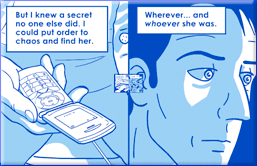
I created the images used in this work. I reserve all rights, etc. If you want to use the images, send me a message.

Sunday, September 16, 2012

Pre-Post Production

PRE:
This week, I took time off of formal research to research effects that I need to use to get my film to look the way I want it to look. Post production is a hugely important step in the film making process, and often times, we think of it last. I am trying to avoid this mistake and am considering some of what I plan to do in post now instead of later.

Part of the justification for putting other research on hold is that I intend to have an effects-heavy work. As I mentioned in my first official post about the project, I am looking to present a world shown as a combination of impressionism and cubism; this ties into my overall story, which follows a man who (following and accident) has a device that uses sound to create images. In the process of creating images, things like color and the refraction of light are difficult for the device to translate (partly because of noise-interference with the device) and so the image is distorted.
POST:
One of the main sites that I am looking at to help me with post production is Post Magazine. Post offers insights from professionals in the world of post production, who offer everything from technical details about a product to advice on how to run a 'post' studio. While their online content may be limited, I have access to the magazine at work where our post production specialist has a subscription that he shares when he is finished with it. Post can help you know what software to use, and aided me in my quest to get editing software of my own (I decided that Adobe Production Premium met my needs).

Tutorials:
While it might seem surprising, a secondary source I am getting information from is tutorials on youtube. Just as many people are wiling to be interviewed by magazines like Post, many companies and individuals are willing to post awesome tutorials online.

Since I am making a science fiction film, I was looking a lot at compositing (for spaceship sequences, potentially) and generic video effects (to learn how to show an impressionist-cubist world). I'm excited with what I've seen so far, particularly this video which shows how to create a realistic-looking planet in about two minutes!


I still have a lot of research to do with post production and effects, but I am thrilled with the results I have so far. If you have a favorite effect, feel free to leave a comment with the link; I'd love to check it out.

Sunday, September 9, 2012

Research on Synesthesia

Reviewing sources:
So, for my final project I have several research tasks that must be completed. This week, I spent time reviewing tow books that have helped me ground my project conceptually. Over the next few weeks, I will dive into purely academic papers; however, I thought that it would be good to give my readers a clue as to where I am coming from.

Music Video and Synesthesia:
Synesthesia is my main research topic, and to gain a sufficient basis conceptually I am revisiting Dr. Kevin Williams "Why I [Still] Want My MTV", which delves into the topics of music video and Aesthetic Communication. Williams does a good job of covering the theoretical basis of synesthesia as a phenomena in its entirety.

When I have read Williams' book before, I marked pages pertaining to synesthesia to aid me in putting my current project together. While the text is primarily about Music Video, Williams is thorough in his examination of communication theory; especially as pertains to synesthesia. It fits into my project well, since I intend to produce a film that communicates on more than just the visual level. For a review of some of the concepts Williams deals with in his book check out this post.

Music and Synesthesia:
Over the summer I started reading Oliver Sack's "Musicophilia: Tales of Music and the Brain". If you've read (or seen the movie) Awakenings, you are familiar with how Sacks approaches his topics with a combination of research and narrative.

Sacks work was important to my project because He is a very thorough researcher, and like Williams, includes footnotes citing all his sources and explaining concepts in greater detail. Sack's book deals with the phenomena of music and why we react so strongly to it.
Throughout his medical career, Sacks encountered people who had lost their hearing or had suffered brain damage. In many of these cases, people developed strange reactions to music; everything from hearing music all the time, to having a completely changed way of experiencing music after their accident.
Sacks work ties into my research because he identifies cases of synesthesia explaining several of the causes. He also treats synesthesia as a topic of interest instead of an abnormality to be dismissed; which is critical to developing an understanding of synesthesia.


For a primer on Synesthesia, check out this post.

Sunday, September 2, 2012

Sounds Shadows and a World Revealed

The time has come to announce my final project. While it seems that my time at Shepherd has flown by, I also feel that I am ready to attempt to make tell this story.

The Big Idea:
For several years I have had an idea bouncing around my head. I've always been a fan of science fiction, and as a child I imagined stories of different worlds with my friends. I imagined empires and societies sprawling across the universe, ever an intrigue or war about to start; politics, war, and new worlds all came to life in my imagination.

While I attempted to write some of the stories I dreamed of as a child, it wasn't until recently that the pieces came together as to how to begin the story. I would always begin in the middle of a universe where people were in space, and try to work out details of a story after assuming this huge technological leap forward. Essentially put, I had no introduction to the worlds I wanted to visit (and share with others).

I am going to make a film about a man who must see the world through sound.

Why?
While I want to keep some details hidden for the time being, his story ties into the larger story I would like to tell as an introduction to a new way of seeing the world. It is this change in perspective that drives people to travel the galaxy.

How?
On the theoretical side of my project, I am going to research Synesthesia because this is the way that the man is able to "see" the world.

On the technical side, I am going to spend time researching filters and effects on Adobe After Effects to try and create the look I am trying to achieve. In short, I am looking to present the world as if it were seen akin to a combination of cubism and impressionism.

I am very excited about this project! I hope it will bring together the best ideas and the most compelling stories I have, all while challenging me to use all the skills I've cultivated at school and at work.

Maus and Masks

When considering Art Spiegelman's Maus in the light of Scott McCloud's Understanding Comics, something that struck me was how there is a parallel of how each treats the idea of wearing a mask.
The Use of Masks:
Maus explores the theme of wearing masks in how Spiegelman's father acted in the face of persecution. In chapter six, Vladek and Anja have an opportunity to escape the ghetto and pretend to be Polish. Their act of hiding their identity is shown by them wearing a mask over their face. While trying to hide their identity is simply a way to keep safe for Vladek and Anja, it reminds us that their is a wider world around them; they are alone, but they aren't the only ones who are scared - many of their friends are going through the same thing.

This wearing of masks corresponds to McCloud's idea of why we identify with cartoons. According to McCloud, part of the reason we identify with simplified drawings is that we have to perceive our own faces - for example, most of the time, the only indication that we have that we are smiling is that we feel our smile, we don't see ourselves smiling. That our input is limited to the muscles we feel when smiling gives us a simplified mental image of ourselves; thus, we identify with simplified images of human faces.

Closure:
Another thing that I found interesting about Maus is how Spiegelman uses closure. As McCloud notes, the gutters (the lines in between each panel) enable the reader's imagination to "fill in" the gaps between frames in a process known as closure. Spiegelman uses the gutters to help tell the story. For the most part, the gutters are uniform from one panel to another; however, when Spiegelman wants to communicate the intensity of a moment, the panels will be slanted, or have uneven gutters. This use of gutters highlights important moments and draws the eye to these moments.

While the use of gutters and closure might seem subtle, Spiegelman is telling a story that requires subtlety. The memories that he is relating are very difficult to process, and even something simple the way the gutters are used can make a difference to the reader. Playing with format enables the writer to immediately communicate details about a scene; and adds depth for a second reading. Maus is a graphic novel that requires several readings to fully comprehend; it keeps communicating something new each time you pick it up.


Friday, April 20, 2012

A Moment in time

Time...

A moment in time, that's what I was trying to create.

Everything came together beautifully. I was happy with the final product.

When I got to the shooting location, I was impressed by the volume and intensity of the water that cut through the location. I had intended to use the town run and river, but I did not anticipate how much I would like the footage I got from there.

I had intended to use the river as a series of cut scenes, coming from a studio with a black background where a man was setting up potted plants; but when I arrived at the rivers edge, I was taken aback by how beautiful the scene was.

The original intent of the project was to show a moment in time, and the moment I envisioned was one of that brief transition between early and mid spring. While I had thought to use special effects to help show that transition, I revised that notion when I saw how interesting the river shots looked. The water flowing kept a steady movement, almost an inevitability; much like the onset of spring.

Another bonus that came from the river shoot was that there were many plants budding at the town run's edge. I experimented with rack focusing, and feel that I captured the element of change with those shots.

Overall, this was a challenging, but very fun video to make.


Critique of "Whistle"

"Whistle"... what worked, and what didn't:

After finishing my music video, I have to look back and decide what worked and what didn't work about my video.

I ended up making a different video that I thought I would. My original goal was to show a moment in time. I envisioned it being told through using a studio with a black canvas, with a man setting up trees and props that would turn into life-size trees through special effects (using a lot of fading and rack focusing). After reviewing the footage I had from my outdoor location, and having used the studio for another project, I decided to cut out the portions of the video that had the studio. (For a review of my artistic intent, click here.)

Review of effects:

The rack focusing worked; it really helped set the scene, and get across the idea of the revelation of the moment in the mind of the viewer.

The ambient sounds worked. I had to fill the left channel on all of the shots of the town run, and adjust the levels so that the sounds were consistent, and so that they didn't overwhelm the music.

The camera movement worked because it fit into the feel of the video. The video has significant movement; but this is okay because it keeps interest in a scene that would otherwise get boring. I intentionally used a small steady-cam rig instead of a tripod, because I knew that there needed to be movement to keep interest and to enable natural looking transitions.

The music itself worked. I was very happy with how the music turned out because I produced it myself, and I'm often very critical of my work; however, I think that the music fit the scene well. One effect that I was pleased with was how the music seems to express open space; this was achieved by cleaning up the EQ of the song and adding a reverb (which I did with Garage Band).

Overall, the lighting was good. Believe it or not, I didn't adjust the lighting of the shots by the town run. For me, this helped reinforce the point that good set-up can save you a lot of work. The only place where I adjusted lighting was on the first and last clips; I wanted a little more highlighting on the water as the ripples played across the screen.

The editing was good, meaning that the cuts made sense; I successfully edited on an aspect-to-aspect revelation of the scene. I was unsure that this would work, but I was very pleased with the result. One thing I might have done differently would be to experiment with artificial blurring; I tried to capture all focusing effects with the camera itself, but it would have been interesting to see what artificial focusing is like.

Another aspect of editing that I like is that there was a clear beginning, middle, and end. With a non-narrative format to the music and editing, I feel that there needed to be a clear structure to the video. Maybe in future projects I'll attempt to make a non-narrative video without the three part structure; but for this project, I think the structure worked.

The colors worked; most of the footage was good to begin with, but I edited the beginning and end shots to change the tint to a warmer color. This was done to highlight the water, and also to differentiate the beginning and end from the middle.


Finale

Once again we've come to the close of a semester, as such, it is necessary that we should review the literature and concepts that we've been exposed to over the course of the semester.

Discourse is an invaluable tool to society, but is artificial.

In my previous blog post, I argued that Synesthesia is either the basis for communication and building signification, or at very least is an integral part of it. In coming to a conclusion about the discourse and aesthetic style known as Music Video, we must remember that aesthetics are a human construction. In remembering that aesthetics are an expression of a naturally occurring phenomena, we are reminded that perceptions are built and; therefore, should not be taken for granted.

A perception can, and does, reveal truth about the world; but at the same time, you have to remember that the means and codes of communication that build that perception are not in of themselves 'truth'. Expression comes from an understanding of perception; and an expression must always make assumptions about the world - this is the nature of a discourse.

And discourse enables great things to happen. Discourse is the process of building ideas; it could be argues that discourse encompasses the mythos of "scientific progress"; where each generation of scientists builds on the ideas of the previous generation. It should be noted that this is a myth, and that scientific progress does not often occur along a strictly linear progression; but it is still a useful metaphor for how discourse works.


Tuesday, April 17, 2012

The three S's

Signifier Signified, and Synesthesia:

What is Synesthesia? Synesthesia occurs in as an experience where one sense picks up data from another (seeing texture, for example 1). I maintain that synesthesia is the basis of building significance.

Signification is constructed out of signifiers. A signifier is any thing that points to something else. Signification occurs because human beings love to learn; and what's more, we love to associate data or an experience with something in order to use that information later. This is either a survival technique, or something that is innately part of being human; whatever the case, this seems to be a universal experience 2.

Having a favorite song helps us make sense of the world, or how the world ought to be. In listening to a favorite song, we find that our emotions are stirred, and that we begin to associate imagery (or experience) with what we are hearing. This is a level on which we all participate in synesthesia.

But is synesthesia really the process of building significance? It can be argued that because we don't have the language to describe a new thing when we first see it, we borrow other words and ideas to help us explain to someone else (or ourselves) what we have just experienced.

Even if synesthesia is not the basis of building significance, it nonetheless is in integral part of the process of signification.

_____
Sources cited: Williams, K. Why I [Still] Want my MTV

1 - On page 184, Williams describes the senses that are activated when watching Music Videos. Many of the phrases that come up in reviews of music video are expressed in terms that line up with synesthesia.

2 - On page 175, Williams discusses how the phenomena of synesthesia is a universal experience, but how the scientific and cultural community has rejected it for some time; however, research has been done to conclude that synesthesia is, in fact, universal.

Tuesday, April 10, 2012

Is this real life?

Reality... is a tricky thing.

One might argue that it is impossible to express, and is only available by living it.

Existentially speaking, we cannot create reality; we simply are in it. Although, I am making the assumption that, my reader, exist (which has to be taken on faith, I'm sure).

Why bring up such an existential problem in this blog? The answer is this: When we create media, we are referencing reality. Even ideas that come to us in dreams, fantasies, etc, are based on reality (perhaps in that they are not "as things should be" that is, they seem unreal).

More often than not, when creating media, our aim to to go beyond referencing reality... We are attempting to create something that expresses a truth about reality. This often comes about in the guise of "seeming" real; creating a work of art that resonates with the "image"(1) of the thing itself.

Flip it around:

Here's the catch: We forget what we are watching. In reading this far into my post for today, you may have forgotten that you are staring at a computer screen. I don't say this to seem "far out" or deep, I merely wish to point out that learning about media changes that way you see media (2).

In creating media, one is forced to move from criticism to expression; and this move cultivates an awareness of how unreal the medium is. A painter may be filled with emotion while creating a work, but feel nothing afterwards, save an echo of the emotions when present when the work was created.

I often find that, since working at a television station; I can no longer look at live television the same way... I am too familiar with the processes that are going on behind the scenes to simply watch television (3) as I used to. On a side note, this annoys my friends and family to no end when I pick apart details of a show while they are trying to watch it.

Final word:

Knowledge comes with a price. Ignorance my not be bliss, but neither is knowledge.

If you are to become a media critic, know that you will have to give up the way you once looked at the world. But then again, things are pretty cool on this side too...

Source cited: Williams, K. "Why I [still] want my MTV: Music and Aesthetic Communication"

1 - As Williams notes, in most criticism of Music Television, the visual side is emphasized sometimes to the exclusion of the aural side of a music video. On page 134, Williams notes that music more closely reflects the mental "image" of an object or scene than sight does.

2 - This happens in expression and criticism, because you take the position of a creator instead of a consumer; which is a more active role. This holds true not just for music video, but for media criticism in general. (I don't have a specific source for this, I just feel that this holds true)

3 - On page 144, Williams cites Zettl who draws attention to the fact that a directors job is to direct attention. When you study to become a director, you become aware of the tricks used to direct your attention.