Friday, November 18, 2011
Advertisers and Artists
Wednesday, November 2, 2011
Signifier-Signified
Wednesday, October 12, 2011
Song of Ike and Fire
As I mentioned above, the use of pathos (in memorializing Eisenhower), logos (in appealing to intelligence), and ethos (in showing that the man on the street will get answers from Ike) were effective. Eisenhower comes out looking like a larger than life character who is concerned with the little guy - a good president.
As I mentioned above, Song's target audience was Women - who their research indicated felt like they had no airline tailored to their needs. Taking this information and failing to capitalize was (in my opinion) due to one key factor: They treated Women as if they had no brain. You cannot sell an airline to anyone unless they are convinced that it is a good idea (either through price, shorter flight durations, no baggage fees, etc...).
If they had focused on building the cult-like following to the on board experience, Women would have been drawn to the airline for rational concerns (price, etc) and would have stayed with Song because of the positive experience.
Monday, October 3, 2011
Response to "5 Bad ideas..."
So, while browsing through the blogosphere went to Cracked.com a class mate came upon the article "5 Bad ideas for Dealing With Bullies You Learned in Movies", another post in a column about Hollywood and Main street's bad ideas. It seems that Hollywood and the rest of life is full of bad ideas... not a big shocker.
The column highlights everything from why Hollywood doesn't understand technology to why web designers don't understand the internet, to things people get wrong about everyday life. The column always focuses on (about five) things people get wrong about "X".
The dilemma:
My classmate was reading other articles on Cracked, which describes itself as a humor site., when he came upon the article in question. The articles before had been lighthearted and very funny. When he started reading "Dealing With Bullies" he was shocked at how real and personal the author got about bullying.
The author talked about his childhood and difficulties that he had with bullies, difficulties ranging from getting beat up every day to having to move away because his life was threatened. For someone who was expecting another humor filled, uplifting article, this didn't deliver.
My classmate asked the question: should a humor site should have a warning if the topic is going to get to serious?
My take:
After hearing about this situation in class, I decided to investigate for myself. True enough, Cracked.com is very funny and uplifting for the most part. Comparing it to the article however, I saw the disconnect. The article makes dozens of pop-culture references and gives pretty decent advice in the end. But it is a downer.
That being said, I found the post to be very compelling, and interesting. After reviewing the site and the post in question, I feel that the author was not really out of line. The article was not dissimilar from most of his other list of things people get wrong - it was clearly the same column.
The difference is that this subject is more somber than his usual fare. While this was off putting at first, I read the article again and noticed that he was asked to talk about bullying and give his advice. Considering that he runs a humor/advice column, it is not unfair that he respond to a request for advice even if it is not very humorous.
I think that for someone who was bullied, the article would not be a downer: he talked about what really happens and how people are confused about the subject and build up a mythology about nerd revenge. You can find the humor there, with plenty of zingers and movie references it was a good read.
Final word:
In my opinion, if your readers ask you to talk about something that is normally out of context with your writing, as the writer you should have the option to respond. Just be courteous and give warning.
Friday, September 23, 2011
Advertising campaign

Uni- http://www.flickr.com/photos/sierraromeo/


Sunday, September 11, 2011
Music Video
Actions have consequences, the individual (in this case a white husband and father) must be careful of their actions. The series of events unfolds from one compromise of morality leading to another; which ends with the dissolution of the family. The audience must review the man's choices as they are transported through a world of what-if.
Women are depicted in two ways one is the wife/mother figure. The other is the woman who represents temptation. The leading figure in the video (the husband/father) makes a series of choices between loving his family and pursuing temptation. At the very end of the video, we see the man's daughter - the littlest one of the family who is being lead astray. This is an appeal to the father for his duty to check his desires and motivations in order to protect his family; and is relevant because it illustrates the idea that children who are learning their gender role must need a stable marriage.
Women are presented in two ways: one as the wife and mother of the man's children, and the other as the temptation. We see this in the temptations that the father and son undergo. Both have disregarded their family in order to chase temptation (in the form of a woman).
There is no rewind button to life -this was a powerful theme that came up in the video; it is completely opposed to the idea of youthful adolescence going on forever. The proper role of men in this video is counter to that which was presented in Dreamworlds by Sut Jhally. This video is almost a response to the culture of adolescent sex-obsessed masculinity that Rod Stewart seems to embody for Jhally. Living in a fantasy world (and acting out the desires of such a fantasy) is presented as incredibly negative, leading to an endless number of problems.
The temptress-women are presented in a way that uses the male gaze. The shots do not have them looking right at the camera, but instead have them making some kind of sexual appeal to a man. While this might positively reinforce the permissibility of the male gaze in a regular music video, in this video it is a symbol of danger and failure. The male gaze is used as a readily recognizable symbol of temptation.
In this view of a possible future, denying people their subjectivity (through objectification of women, and failing to recognize the duty he has to his wife -not treating her as if she has a right to fidelity) has lead to the collapse of this man's family. Living in a way that denies subjectivity and encourages objectivity is shown to be destructive.
Women who encourage objectification are seen as part of the problem; but do no come out as the ultimate recipient of blame. It is up to the man to keep himself from temptation, and preserve his family in the process.
The video seems to challenge all the ideas that Jhally talks about in Dreamworlds. That being said, the traditional roles of women are not challenged; it is merely that the man must maintain his duty to his wife and children by being moral upright in all his doings.
Friday, September 2, 2011
Firth analysis
Firth analysis is a tool for the critic and the producer of advertisements; it helps both parties examine an ad for meaning and cultural significance.
Using the Firth method, you examine an ad in terms of three levels of meaning: The surface meaning; the advertiser's intended meaning; and the cultural/ideological meaning.
A Firth analysis goes something like this:

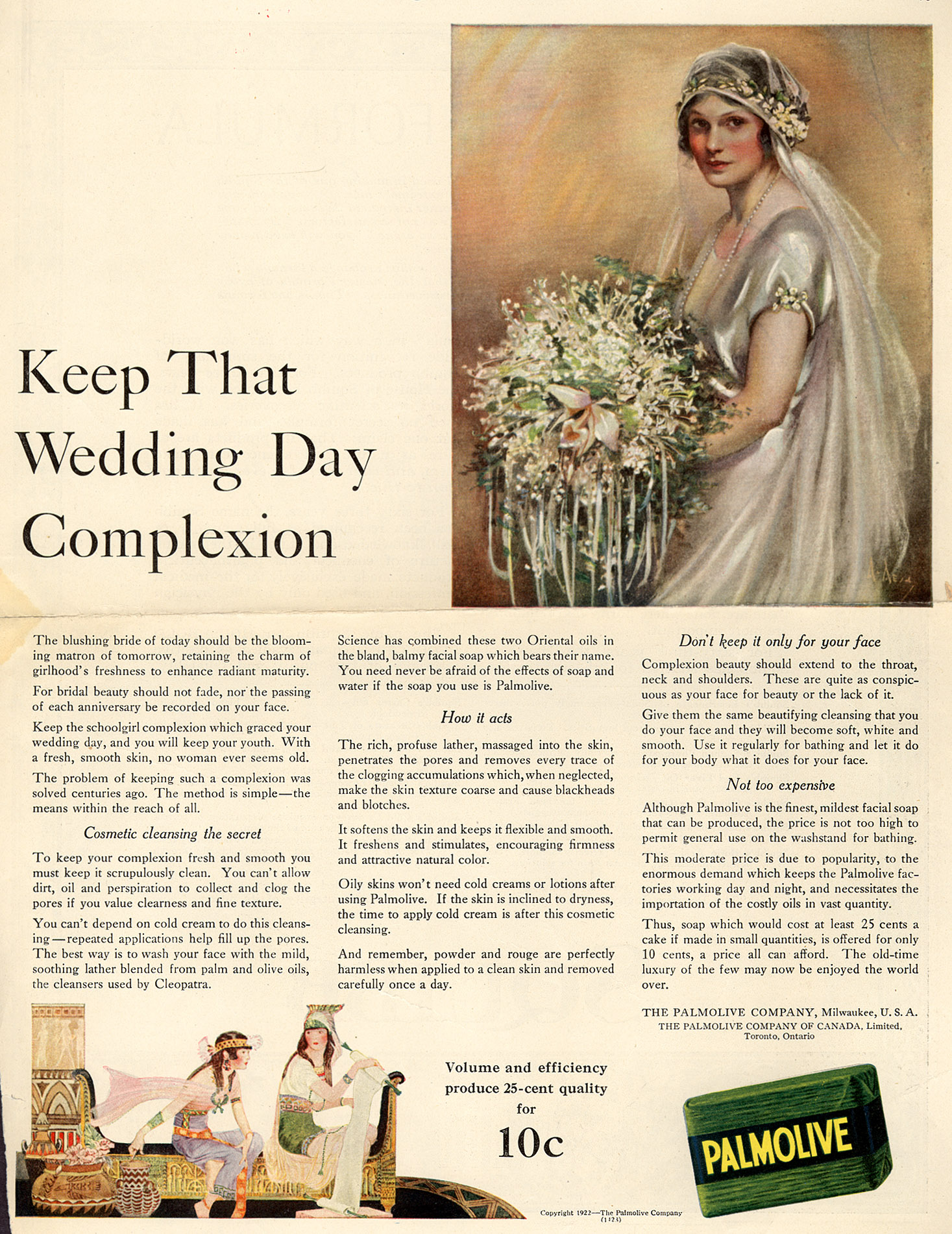
In the lower right we see the a bar of Palmolive soap in green packaging with yellow letters on top of a black background.
In the left corner is a representation of Egyptian women who seem to be working with cloth while sitting on a couch.
The advertiser is trying to tie the product to good feelings about weddings, and the idea that their product will enable women to look as beautiful every day day as did that day.
The images in the ad are meant to convey that this soap works very well at cleaning, and will enhance the users appearance.
The text in the ad is meant to encourage the reader to buy the product, noting its affordability, effectiveness, and that it is good for everyday use.
Using the wedding motif, this ad promotes the idea of marriage; and the idea that women should be beautiful.
The bulk of the text gives information about the product, how to use it and how it works. It is promoted as an everyday beauty product - suggesting that women ought to have an everyday beauty routine.
The ad also advertises "Cosmic cleansing" as its secret to working so well. There is an appeal to mysticism in this, and the fact that they depict what looks like Egyptian women in the ad. It is notable that the Egyptian women are sitting - not standing; suggesting that perhaps this is a model that should be followed.
My favorite ad:
I think that this is partly due to two facts: companies are trying to push their brand in new ways; and this generation of advertising executives is more likely than ever to have gone to film school.
That being said, my favorite ad is not from the United States, but from Egypt.
A few months ago I stumbled upon this series of commercials:
There are a whole series of these ads, all having situations where somebody refuses panda cheese, and has the panda make a mess. I enjoy this series of commercials because they incorporate interesting film techniques with a quirky sense of humor to deliver a fantastically memorable ad.
Sunday, May 1, 2011
Fin...
As this semester is coming to a close, I wanted to write a final blog post for this semester that looks back on how the semester went, and what I've learned this time around.
Here are some of the important things that I learned over the course of this semester:
Careers in communication.
I learned about how important networking is in getting a job the the communications industry. This was useful because it helped me examine what I need to do to prepare for a job in in communications industry.
Media Literacy.
Exploring media literacy, I investigated the purpose of advertising and the reasons that people create adds. This helped me remember that in order to express, one must also be able to criticize.
Comics:
I learned that there is an exciting crossover in the worlds of comics and film. This project challenged the way I think about framing and television.
The internet at 20:
Looking back on how the internet has developed and changed the way we communicate has given me the opportunity to see how technology interacts with the society. This has been useful because it reminds me that an innovator is always looking out for new technology and new ways to use current technology.
This semester has challenged the way I think about media, going from a discussion about careers in media, to media theory, to media creation has been a wild ride.
I will continue to write this blog for other comm classes, so check in again in the fall.
Wednesday, April 20, 2011
VALS and Values:
Achievers are goal oriented. They are people who are deeply committed to their family and careers. To quote the site: "Their social lives reflect this focus and are structured around family, their place of worship, and work. Achievers live conventional lives, are politically conservative, and respect authority and the status quo. They value consensus, predictability, and stability over risk, intimacy, and self-discovery." Achievers are focused on buying products that show that they are accomplished.
Experiencers are, well, all about the experience. They love self expression, and being creative. The site has this to say about experiencers: "Young, enthusiastic, and impulsive consumers, Experiencers quickly become enthusiastic about new possibilities but are equally quick to cool. They seek variety and excitement, savoring the new, the offbeat, and the risky. Their energy finds an outlet in exercise, sports, outdoor recreation, and social activities." Experiencers like fashion and focus on buying things that make them feel good or that are new. Experiencers like having cool, new stuff

I'm not sure either of these really are a good representation of what kind of consumer I am.
First of all, for the most part, I don't like to shop. Both categories mentioned fashion, which I do not care about. I like looking good, but I primarily look for function when shopping.
I don't know how accurate this survey was. I'm not sure which category I think I should fit into, but I didn't think that the survey was particularly accurate; perhaps I just don't see myself as a consumer.
I almost like top think of myself as being outside the world of products and advertisement. Is this just ego? I don't think so, because I think of myself as someone who is hard to sell to. I don't go shopping for new gadgets, and I don't watch television (which means that I'm not bombarded by adds all the time).
Maybe I can't see my own consumerism... this survey has been useful as it made me question whether I fit into the system of capitalism in my culture. Interesting...
Friday, April 15, 2011
The internet and the idiom:
Over the course of my life, the internet has gone from something nobody knew about, to something Filipino 12 year-old's are teaching their grandparents how to use.
Twenty years ago, Tim Berners-Lee saw the internet created "on his desk" in Geneva Switzerland.
He wrote this article about where the internet has come, and about where it needs to go. He had six basic premises about the internet, that: Universality is the foundation; Open standards drive innovation; Keep the web separate from the internet; Electronic human rights; No snooping; and Linking to the future.
Now, I'm not going to describe the entire article:you can go here if you wan to read it.
What I am going to do is describe the part of the article that I found most interesting: Electronic human rights.
To give a little perspective on how important this issue is, we should consider the influence of social networking in the recent protests and revolutions across the middle east. Sites like Facebook Twitter, and a host of others were used as communication channels for protesters to either publicly, or privately (and thus without fear of repercussion) publish their views.
The ability for people across the world to express themselves is a huge step for democracy. People are able to challenge their government to do better, and are able to connect with people who are running for office but are shut out of the state-run media. This is part of the reason Berners-Lee says that access to the internet has been deemed a fundamental human right by the UN.
That people should have access to the internet is vital. While we may not like everything that is on the internet, we sill must recognize the good that can come from it. Protecting access to the internet, and improving wireless internet infrastructure in developing nations will result in a better educated, and better informed populace.
Wednesday, April 13, 2011
Maxx-ing the use of frame
Greg Smith's "Shaping THE MAXX: Adapting the Comic Book Frame to Television".
Interesting stuff right?
For those of you who haven't read it: In his article Smith argues that Television should experiment with new frame sizes; that TV shouldn't be limited to the 1:33-1 ratio of frame size. Smith also argues that TV should use more frames within the frame of the screen - and that producers should be aware of how effective this has proven in comics as well as in the animated adaptation of The Maxx.
These ideas are very interesting (to say the least); however... they are also risky. Financiers and investors (almost the same thing) do not want to bet their fortune on something unproven, they want something that has been done before. This is both positive and negative, as there is stability within the industry which this comes at the expense of artistic license on the part of the creator of the work.
What producers of content need to do is to show that using different frames is effective as a storytelling technique. Maybe if there were more people creating media that doesn't conform to the standard frame ratio, and more content that uses frames within frame, we would see more programming like "The Maxx".
Smith makes a good point: Creators need to be courageous with what kind of art they make, and audiences should be accepting of new art forms.
Final question: Would "The Cape" have been canceled if they had tried to use some of the techniques Smith writes about? Or would it have been a more interesting way to tell the story, leading to its success as a show?
Unless people start experimenting, we'll never know.
Sunday, April 10, 2011
Reality, Fantasy, and 3D:
Understanding 3D is important to being able to understand why it doesn't work, how it could work, how critics of media should approach 3D, and how producers of media can use 3D effectively.
The basic problem with 3D is that it feels unnatural. This may seem like a weird statement because we experience the world in 3D, and expect that 3D movies should feel more natural and lead to greater immersion than "regular" movies. Our expectation, and the expectation of investors in 3D technology is that 3D will just be better than normal movies. In my own experience, this is not the case. Basically, I have just rehashed what Alva Noë argued in her article The Myth Of 3-D Immersion.
I think I might be able to explain the failure of 3D:
The prevailing philosophy behind 3D is that because we actually experience the world in 3D, we will identify more with 3D stories. The astonishing thing about this assumption is that it is so close to being right, but yet misses the mark completely.
We live in a 3D world, this is true. We identify with stories told in 2D (with or without the illusion of depth). I argue that the failure of 3D is that it looks too real. In2D mediums, there is a natural amount of aesthetic distance that comes with knowing that the thing you are watching is not real.
3D technology as it stands is either too real, or very, very... fake. Either of these extremes pretty much spells out death for a storytelling technique. Having it look too fake is distracting, and makes us realize that we are seeing a special effect. Having it look too real turns us off because we lose that comfortable distance that allows us to experience the thrills of a movie without the consequences.
3D is striving for virtual reality, but would we like it if we had it? Wouldn't virtual reality be abhorrent to us? Does a virtual world that you couldn't distinguish from reality sound like fun? Think of any realistic war movie, and picture it in virtual reality. Not so fun.
What movie-goers want is an escape, not a trip down the rabbit hole.
Now in 3D:
Now, I'm not going to give a critique of the film itself because Legacy was my introduction to the world of Tron and I don't think I should critique the movie itself without having seen the original. However, I what I am going to talk about is the film's use of 3D.
In Tron: Legacy, 3D was used to help reinforce the digital feel of "the grid". 3D effects were used as in the movie to make the motorcycle ride at the beginning of the movie seem more exciting, and were used once Flynn gets on the grid so that the movie-goer would remember that the grid is a virtual reality(VR). Overall use of 3D made sense in the movie. It was a rather distracting to go from a scene without 3D to one with it, but again... overall it made sense (given that it was VR).
That being said, I was not thrilled with the experience. As Noë put it "3-D is thrilling, surprising, and slightly upsetting" what it does not deliver is what 3D movies promise: immersion into the world of the film. When 3D was used in Tron:Legacy, it was not subtle - You knew you were seeing something in 3D.
Where am I going with this? Here:
Tuesday, April 5, 2011
Looking back

Sunday, April 3, 2011
"Drive" review:
As a mass communications student, I aim to investigate all kinds of communication, not just film and video. The world of comics and graphic novels is an exciting one, full of storytelling devices. Through a process known as synesthesia, comics and graphic novels have to communicate things like sound and smell through text and pictures; which makes them a fascinating example of communication because they must communicate something that is experienced by another sense (sound through words, fro example). As always, to examine and review a work we need criteria. These criteria are: 1) Words; 2) Pictures; 3) Frames; and 4) the interaction of these three.
"Drive" by Dave Kellett, is an example of a comic that uses the aforementioned methods to tell a interesting story. It takes place far in the future, where one man accidentally finds a spaceship that "pinches" space enabling warp speed travel, and uses this to build an empire based upon his family's control of the transportation system. In this way it is somewhat reminiscent of "Dune" by Frank Herbert. However, "Drive" stands on its own feet as a believable and interesting universe.Words:
In Drive, words are used both in and out of the picture-story continuum. Words are used as a device to introduce classified documents, private letters, and character dialogue. In the case of letters and documents, these are used to reveal necessary exposition for the story.
Looking a little closer, we see that the words are not all the same size. Words are made smaller and larger to emphasize how the words are supposed to sound. Pictures interact with the dialogue by giving the character an expression to match the text.Pictures:
Throughout the story, Dave Kellett creates a fantastic world that fills the background of the comic. His characters go from being on board a spaceship, to being inside buildings, to vising other planets; the setting is vast and the pictures reinforce this throughout the work.
Even in the first few pictures in the introduction, we see a large universe. Pictures are used to set the mood, and to add depth to the story. In the example above, pictures interact with words to give the feeling of loneliness. Pictures interact with framing to show changing viewpoints: the "camera" (forgive the expression) goes from a close up to a wide shot, etc, to help tell the story.Frames:
Framing is used to shift the perceptual distance from an something in the story. Framing allows the reader to be taken close to something one moment, and distant from it the next. In story telling this is an important tool as it allows the reader to experience more of the world, and it allows for an easier transition from scene to scene.
Framing is used to change perspective. In the above scene, the viewpoint shifts from one characters perspective to another. This establishes a relationship between the two characters, we are "told" that they look at one another. Framing works together with picture and text to establish power relationships within the story; for example: who (literally) looks up to a particular character?Interaction:
In Drive, we see a comic where words, pictures, and framing work together to tell a compelling, interesting, character-driven story. Dave Kellett is an artist who understands the new methods of story telling, and how all the facets of a story can work together to tell a good story.
In the world of comics and graphic novels, "Drive" does a good job as an example of how to tell a story.
Thursday, February 24, 2011
Media literacy
A straightforward method of understanding media is to know the five basic concepts that form a text and the five questions we should ask when examining a text. To learn these five questions and concepts, we will examine an ad and ask see how they relate to the text.
1
Core concepts and questions. (Answers)1. All Media messages are constructed. Who created this message?
(The short answer is Burger King. They hired a large team of artists and production people to create the concept and to physically make the ad.)
2. Media messages are constructed using a creative language with its own rules. What techniques are used to attract my attention?
(In the editing process, the editors highlighted the woman and the burger while darkening the background. This draws our attention to the burger and the woman who is consuming the burger. The facial expression of the woman is also used to attract our attention, she looks shocked at the experience of eating this burger.)
3. Different people experiece the same message differently. How might people understand this message differently than me?
(There are always a plethora of perspectives on any text. Some people might read the words "It'll blow your mind away" as innuendo and argue that this text is using sex to sell burgers. Others might argue that the ad isn't sexual at all, and that the catchphrase is meant to suggest some sort of 'burger enlightenment'. Both of these readings are valid, and this text could be interpreted any number of ways - the key is to support you hypothesis with your knowledge of theory.)
4. Media have embedded values and points of view. What lifestyles, values, and points of view are represented in, or omitted from, this message?
(The primary points of view this ad is trying to communicate is that Burger King is better than their competitors. If you interpret this ad as containing innuendo, you might make the case that it supports sensuality. Ultimately, it is the intent of the creator of the ad to appeal to as many people as possible while not offending too many people, so this must be taken into consideration when determining what the philosophy of the text is.)
5. Most media messages are organized to gain profit and/or power. Why was this message sent?
(To sell the Burger King super seven incher, to attract customers to Burger King, and to persuade the audience to associate positive thoughts with Burger King.)
So as you can see, media literacy is an important skill set to attain, and so long as you are well-grounded in communication theory you will be able to use these five simple questions to examine texts and understand them.
Here are the sources I used:
1- This site compares and contrasts images from different fast food companies. They have a lot of useful images and interesting criticism.
2- Dr Kevin Williams book "A media studies reader" Cognella. 978-193555156-0 was referenced in the creation of this post.
Wednesday, February 9, 2011
Careers in communcation:
When attempting to build a career in the film industry, it is incredibly important to join a professional organization designed to serve people in your profession.
Regardless of where you stand on unionization, there are professional organizations and unions that protect the worker and help them get ahead in their career field. Today, many unions are more akin to social networking services than to teamsters.
Also, the union today is run by people who have worked their way up the corporate ladder, and are interested in helping others to do so.
In the world of media and film, joining a professional organization is almost always required. To be an actor, director, radio personality, or television star requires that you join an organization in order to be eligible for hire.
Organizations such as: The International Federation of Actors (FIA), the Screen Actors Guild (SAG), the Directors Guild of America (DGA), the American Federation of Television and Radio Artists (AFTRA), as well as smaller organizations such as the Voice Acting Alliance can help you understand how to build your career in theses fields, and some even offer online forums where you can write people in the industry for advice.
So, to sum it all up: joining a union can help educate you on how to get into your field of interest; it can build your career by making jobs available to you; and it can get you in touch with people in the industry, which leads to more jobs.
Here is a list of resources to help build an understanding about what a union is:
Example of a forum where you can ask experts for help.
All other information comes from the hyperlinks provided above.